FIVE THINGS TO KNOW…

Short explainers published throughout the day.

1:18 PM7-minute read

ABOUT THE NEW SWS POVERTY NUMBERS

Self-rated poverty and food poverty declined in June, but the figures also show how many Filipino families remain under pressure and why lower household budgets do not necessarily mean life became cheaper.

Read the explainer →
2:02 PM11-minute read

ABOUT THE CHILDREN'S SOCIAL MEDIA SAFETY ACT

House Bill No. 9965 would bar children below 13 from having social media accounts, require parental consent for users aged 13 to 17, regulate platform algorithms, and impose fines reaching P50 million. It is still being deliberated in the House.

Read the explainer →
12:02 PM7-minute read

ABOUT THE SEALED BIR BOX

Marcos authorized the BIR to comply with the Senate subpoena. That did not open the records to the public or prove the unexplained-wealth allegation.

Read the explainer →

MCT READER PULSE · MCT-PULSE-2026-007

MCT READER SURVEY

House prosecutors are considering whether to stop presenting evidence on the bribery article against Vice President Sara Duterte and move directly to the unexplained-wealth charge. Do you agree with that strategy?Pinag-iisipan ng mga prosekutor ng Kamara kung ititigil ang paghaharap ng ebidensiya sa artikulo tungkol sa panunuhol at tututok sa kasong hindi maipaliwanag na yaman laban kay Bise Presidente Sara Duterte. Sang-ayon ka ba sa estratehiyang ito?

Some prosecutors want to move directly to the unexplained-wealth charge; others want to proceed with all four articles. No final decision had been announced when this survey opened. The question is about prosecution strategy, not guilt.

Background: The Philippine Star and Daily Tribune.

This is an informal survey of verified MCT readers who choose to participate. It is not nationally representative.

Open the shareable survey page →
View previous survey results →
Checking your reader session…

August 19, 2026 · 9:00 AM6-minute read

FIVE THINGS TO KNOW ABOUT THE PHILIPPINES–US DISASTER-RESPONSE TRAINING PARTNERSHIP

The program has trained senior officers since 2016. It is a disaster-planning course, not a newly announced ten-year military pact.

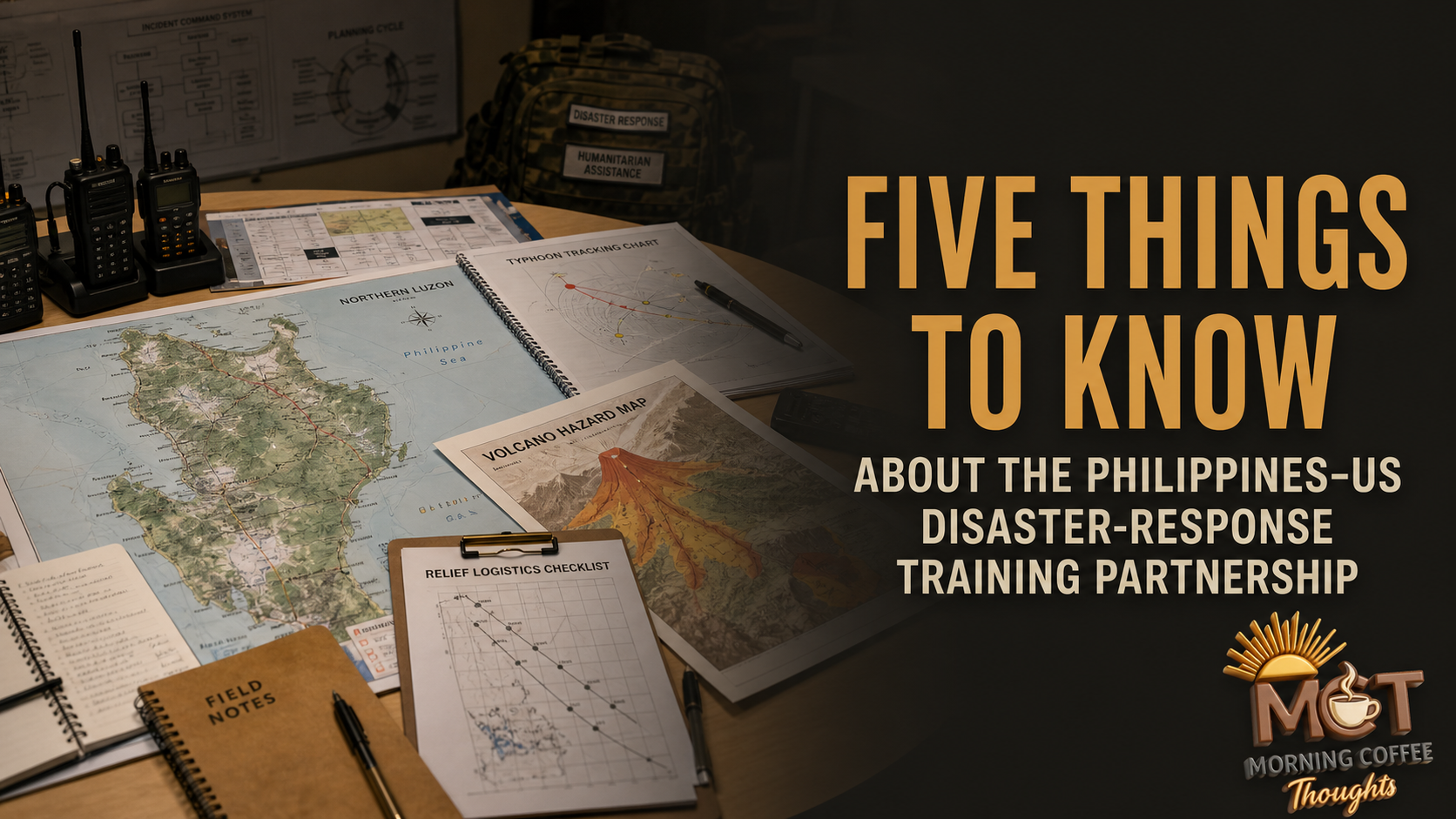
MCT explainer cover showing a disaster-response planning table with Northern Luzon maps, radios and relief logistics notes

The Philippines and the United States have marked the tenth year of a military training partnership focused on humanitarian assistance and disaster response.

The anniversary is easy to misread. It is not a new ten-year military pact and it does not create a foreign disaster-response force in the Philippines. It marks a course that has been taught since 2016 to help senior officers plan for large emergencies.

Here are five things to understand about the program.

1

THE PARTNERSHIP BEGAN IN 2016

The Center for Excellence in Disaster Management and Humanitarian Assistance began working with the Armed Forces of the Philippines Command and General Staff College in 2016.

The aim was to add a humanitarian assistance and disaster response module to the college curriculum. Senior officers study how military units coordinate with civilian agencies, local governments and international organizations when a disaster overwhelms ordinary systems.

The tenth-anniversary course was held at Camp Aguinaldo from August 4 to 6, 2026. The anniversary describes how long the training relationship has existed. It is not the term of a newly signed treaty or agreement.

WHAT TO WATCH

Whether the course remains part of regular AFP professional education and whether graduates apply the procedures in exercises and real emergencies.

2

THE COURSE IS ABOUT COORDINATION, NOT COMBAT

The training focuses on planning relief operations, sharing information, moving supplies and defining the roles of military and civilian responders.

Disaster operations can involve the AFP, local governments, national agencies, hospitals, humanitarian organizations and foreign partners. Confusion over who is responsible for transport, communications, evacuation or relief distribution can waste time when people need help immediately.

The course therefore concentrates on command relationships and practical coordination. Its purpose is to help officers support a civilian-led disaster response, not to teach battlefield tactics.

WHAT TO WATCH

Whether future exercises include local disaster offices and civilian agencies, since coordination cannot be tested properly if only military participants are involved.

3

MORE THAN 200 OFFICERS JOINED THE ANNIVERSARY COURSE

The August course included 204 senior field-grade officers. Of these, 192 were from the Philippines and 12 were international students from Indonesia, Malaysia, Australia, South Korea, Thailand and Cambodia.

Specialists from the United Nations Office for the Coordination of Humanitarian Affairs and the World Food Programme also contributed to the instruction.

This mix reflects the reality of major disasters. A large typhoon or earthquake can require help from several Philippine agencies and, when requested by the government, international organizations or neighboring countries.

Participation in a classroom, however, does not prove that coordination will work during a real emergency. That can only be tested through exercises, local planning and actual operations.

WHAT TO WATCH

Follow-up exercises, evaluations and any changes made to AFP or local disaster plans after the course.

4

THE SCENARIO COMBINED A SUPER TYPHOON AND A VOLCANIC ERUPTION

Participants worked through a fictional Category 5 typhoon striking Northern Luzon while Mount Pinatubo erupted at the same time.

The scenario forced planners to divide attention and resources between two emergencies. Roads, airports, communications, medical services and relief supplies could all be affected at once. Decisions in one area could also reduce the people and equipment available somewhere else.

The Philippines has experienced overlapping hazards before. Typhoons, earthquakes, volcanic activity, floods and landslides can occur close together. Training for simultaneous emergencies can reveal gaps that are less obvious in a single-hazard drill.

WHAT TO WATCH

Whether national and local plans identify backup transport routes, communications systems, evacuation sites and supply chains for more than one disaster at a time.

5

TRAINING IS USEFUL ONLY IF IT IMPROVES RESPONSE ON THE GROUND

A well-designed course can help officers understand procedures and build professional relationships before a crisis. It cannot fix weak communications, missing equipment, poorly maintained evacuation centers or slow relief distribution by itself.

The public should judge the partnership by measurable improvements: clearer coordination, faster decisions, better logistics, fewer duplicated efforts and more reliable information for affected communities.

The Philippines also needs to retain control of its disaster policy. Foreign assistance should enter only when requested by the Philippine government and should support, not replace, national and local authorities.

WHAT TO WATCH

After-action reports from exercises and actual emergencies, improvements in local readiness, and clear rules governing requests for foreign disaster assistance.

BOTTOM LINE

The Philippines–US program is a decade-old training partnership for senior officers. It is not a newly announced ten-year military pact. Its value lies in preparing people who may have to coordinate the response to several disasters at once. The anniversary course included Philippine and international officers, as well as United Nations humanitarian specialists, and used a demanding typhoon-and-volcano scenario. The program should ultimately be measured outside the classroom. Better plans, faster coordination and more dependable help for affected communities are the results that count.

GOOGLE PREFERRED SOURCES

FOLLOW MCT ON GOOGLE

Google’s Preferred Sources feature lets you choose publications you want Google to prioritize for you. Select “Add to Preferred Sources” to make MCT easier to find in Top Stories and other eligible Google results. This does not subscribe you to email.

← Back to MCT home

LATEST COMMENTARY

View all commentary →

SUPPORT MCT

HELP KEEP INDEPENDENT POLITICAL WRITING GOING.

Morning Coffee Thoughts is reader-supported. Contributions help pay for research tools, hosting, and the work required to verify and explain each development.

Choose the monthly support amount you are comfortable with.Continue through PayPal
Send support through GCash or Maya0969 314 4839