
WHEN CHINAVTV TRIED TO TEACH FILIPINOS ABOUT SURRENDER
ChinaVTV said Filipinos should not complain about being compared to monkeys, then used a distorted version of Philippine history to defend that claim.
7 min read
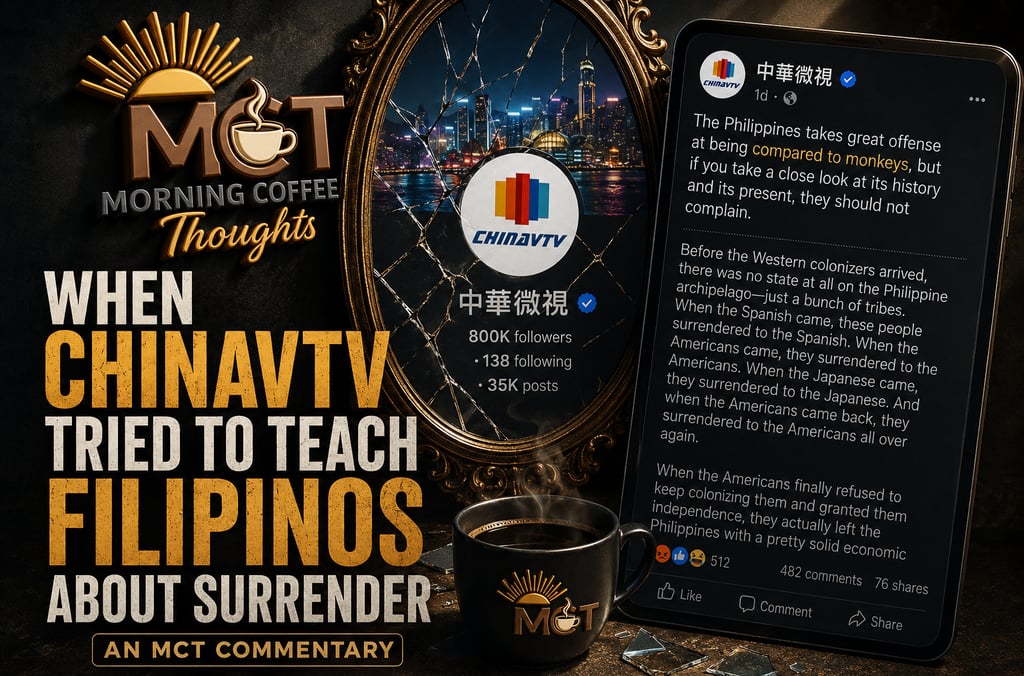
ChinaVTV published a post that called Filipinos monkeys, then tried to justify the insult through a lazy version of our history.
The page calls itself 中華微視, or ChinaVTV. Its Facebook profile carries a Hong Kong contact number, says it has 800,000 followers, and promotes itself with the line “Chinese people around the world are watching.”
Fine. Let them watch.
They should also learn to read history before using it as a weapon against people they clearly do not understand.
The post claims the Philippines had no state before colonization and describes the people living here as little more than tribes that repeatedly surrendered to Spain, America, Japan, then America again.
From there, it blames Filipinos for supposedly inheriting a prosperous country and ruining it, using poverty, crime, political dynasties, Duterte’s drug war, and exploitation as evidence for racial contempt.
It is the kind of argument that looks intelligent only when nobody checks the footnotes.
BEFORE SPAIN, THERE WERE POLITIES
No, the Philippine archipelago did not have one centralized state resembling the modern Republic of the Philippines before Spain arrived. That is very different from claiming there was “no state at all.”
Historian and De La Salle University professor Michael “Xiao” Chua has pointed to Tondo as a kingdom as early as 900 CE. He cites the Laguna Copperplate Inscription, which records an organized government governed through customary law under a leader named Jayadewa.
The document even refers to the settling of a debt. People do not write legal records on copper when there is no political order, authority, or system of rules.
The Sultanate of Sulu also existed for centuries as a Muslim polity with authority over the Sulu archipelago and links across maritime Southeast Asia. Chinese records, regional trade, diplomacy, and local rule were already part of life here long before Spain tried to claim the islands for a king across the ocean.
The word “barangay” gets thrown around today as if it describes a tiny, harmless village. Before colonization, barangays were political communities with leaders, social ranks, obligations, alliances, trade, and customary law.
Political fragmentation does not turn inhabited societies into empty land waiting for foreigners to give them a past.
That distinction seems too difficult for ChinaVTV’s writer.
THE SURRENDER STORY IS A CONVENIENT LIE
The writer says Filipinos surrendered to the Spanish, Americans, Japanese forces, then the Americans again.
History left a far more violent and disobedient record.
At Mactan in 1521, Magellan’s expedition tried to force Lapu-Lapu’s community into submission and failed. Magellan died in battle after Lapu-Lapu’s warriors overwhelmed the European force.
The surviving eyewitness account by Antonio Pigafetta does not establish that Lapu-Lapu personally delivered the fatal blow. It does establish that Magellan died fighting people who refused to submit.
Resistance against Spanish rule continued for centuries, driven by forced labor, abusive tribute collection, land disputes, religious coercion, and colonial violence.
The Katipunan later fought for independence from Spain, and Filipino revolutionaries declared independence in 1898. The Philippine-American War followed when the United States attempted to replace Spain as the colonial power.
During the Japanese occupation, Filipino guerrillas fought across Luzon, the Visayas, and Mindanao. Many died before American forces returned.
ChinaVTV’s version wipes out that sacrifice because acknowledging it would destroy the neat little insult the page wanted to publish.
Losing a war does not prove that surrender is embedded in a people’s character. Colonization is something imposed by power, often after enormous resistance and bloodshed.
THE “RICHEST IN ASIA” CLAIM IS ALSO FALSE
ChinaVTV says the United States left the Philippines with a strong economic base, after which Filipinos ran the country into poverty.
There is a real history of economic decline relative to several Asian neighbors. Political families, weak institutions, corruption, land inequality, poor industrial policy, debt crises, and authoritarian plunder all played roles that no serious Filipino should pretend away.
Still, the usual claim that the Philippines was once Asia’s richest country, second only to Japan, is false. Rappler and AFP Fact Check reviewed historical GDP data and found no support for it.
The Philippines was never second only to Japan by gross domestic product or income per person during the Marcos years.
There was no imaginary Asian throne from which the country suddenly fell. Other nations built stronger state capacity, improved education and industry at different rates, attracted investment, and avoided some of the Philippines’ worst political failures.
That history deserves criticism. Racial pseudo-analysis from a page that thinks “monkey” is a serious political category contributes nothing to it.
OUR FAILURES DO NOT BELONG TO RACISTS
Political dynasties, poverty, pagpag, human trafficking, corruption, and drug-war killings are real problems in the Philippines.
Filipinos have spent decades arguing over whether the country’s institutions can still serve ordinary people. ChinaVTV discovered none of these failures.
Bad leaders get elected, but they also face opposition, investigations, protests, court cases, journalism, and public anger. Democratic life in the Philippines is ugly and frustrating, and its outcomes are often disappointing.
Rodrigo Duterte was arrested in March 2025 under an International Criminal Court warrant over allegations of crimes against humanity connected to his drug war. Philippine authorities arrested him and transferred him to International Criminal Court custody.
His lawyers contest the court’s jurisdiction after the Philippines withdrew from the Rome Statute in 2019. The case remains before the court.
ChinaVTV treats this as proof of Filipino disgrace.
A former president facing an international court over mass killing allegations should disturb every Filipino. The case also exists because the killings were challenged rather than quietly accepted.
Families of victims refused silence while rights groups documented cases, journalists reported what happened, and lawyers pursued legal action. Erasing the issue from public memory became much harder because people kept pushing back.
CHINAVTV SHOULD LOOK AT ITS OWN CONDITIONS
ChinaVTV mocks a country whose citizens openly criticize presidents, dynasties, police abuse, poverty, and corruption.
It should consider the political environment from which it speaks.
Freedom House’s 2025 report described China as having the world’s worst conditions for internet freedom for more than a decade. It rated China “Not Free,” citing extensive censorship, surveillance, arrests, and punishment for online speech.
The Tiananmen Square crackdown remains one of the clearest examples. On June 4, 1989, Chinese troops violently suppressed a movement demanding political reform.
China’s government gave a death toll in the low hundreds, while a declassified British diplomatic cable cited an estimate of at least 10,000 deaths. No independent accounting has been allowed, so no honest writer can present any figure as final.
Chinese authorities have also spent decades suppressing public discussion of the crackdown, particularly around each June 4 anniversary.
Even Chinese artificial intelligence systems operate around political red lines. Researchers found DeepSeek-R1 refused questions about Tiananmen Square and gave evasive responses when pushed.
Separate testing reported far higher refusal rates among Chinese chatbots on sensitive political questions than among major American models.
A media page operating near that political culture should be careful about lecturing Filipinos on historical courage.
A BIG MAP DOES NOT MAKE DIPLOMACY
ChinaVTV mocks Filipinos as a people waiting to surrender to the next foreign power.
Meanwhile, Filipinos have watched Chinese ships harass Philippine vessels near our own waters through water cannons, blocking maneuvers, collisions, and intimidation around Scarborough Shoal and the Spratly Islands.
Beijing speaks about friendship while treating the West Philippine Sea like a private driveway.
In 2016, an arbitral tribunal established under the United Nations Convention on the Law of the Sea ruled that China’s nine-dash line had no legal basis for claims to historic rights over resources within that area.
The tribunal also found that Mischief Reef lies within the Philippines’ exclusive economic zone and continental shelf. China rejected the ruling and refused to take part in the arbitration.
China’s large-scale reclamation at seven Spratly features mostly happened from 2013 through 2015, before the ruling. Its military build-up continued after 2016 through airstrips, radar systems, and other installations.
ChinaVTV may call this diplomacy. Filipinos looking at a Philippine Coast Guard vessel being blocked or blasted with water cannons will probably choose another word.
THE POST EXPOSED ITS AUTHOR, NOT US
Listing another country’s worst problems is easy. Turning those problems into entertainment only takes enough cruelty.
ChinaVTV used Filipino poverty as supposed evidence of Filipino inferiority, turned colonial trauma into a punchline, and dragged Duterte’s victims, exploited children, urban poor families, and people living through addiction or hunger into a racial insult.
None of that offers serious insight into the Philippines. It reveals far more about the people who decided to publish it.
Filipinos have failures worth confronting without excuses. Philippine history also contains communities that lived under colonial rule while resisting occupation, dictatorship, abuse, and theft in many different forms.
ChinaVTV wanted to reduce all of that to monkeys and surrender.
Someone wrote an entire essay and apparently forgot that readers can still check whether any of it is true.
SOURCES
ChinaVTV Facebook profile screenshot, provided by the source page
Intramuros Administration, post citing historian Michael Xiao Chua on Tondo and the Laguna Copperplate Inscription, https://www.facebook.com/OfficialIntramurosAdministration/posts/before-the-arrival-of-the-spaniards-in-the-1600s-the-manila-that
GMA News, post citing historian Michael Xiao Chua on Tondo, https://www.facebook.com/gmanews/posts/according-to-historian-xiao-chua-tondo-is-referred-to-as-a-kingdom-as-early-as-9/10160686
Intramuros Administration, profile of Michael Xiao Chua, https://intramuros.gov.ph/2020/05/12/meet-our-ils-speaker-xiao-chua/
Facts and Details, Pre-Colonial Filipino States, https://factsanddetails.com/southeast-asia/Philippines/sub5_6a/entry-9921.html
Antonio Pigafetta account, discussion of Magellan’s death, https://www.esquiremag.ph/long-reads/magellans-death-history-a00293-20190425-lfrm2
Philippine revolts against Spain, https://www.connexions.org/CxLibrary/Docs/CxP-Philippine_Revolts_Against_Spain.htm
Rappler Fact Check, Philippines was richest country next to Japan claim, https://www.rappler.com/newsbreak/fact-check/philippines-richest-country-next-japan-marcos-term/
AFP Fact Check, false claim on Philippine wealth under Marcos, https://factcheck.afp.com/false-claim-circulates-online-philippines-was-second-richest-nation-after-japan-under-ferdinand
International Criminal Court, Rodrigo Roa Duterte in ICC custody, https://www.icc-cpi.int/news/situation-philippines-rodrigo-roa-duterte-icc-custody
Human Rights Watch, Duterte arrested on ICC warrant, https://www.hrw.org/news/2025/03/12/philippines-duterte-arrested-icc-warrant
Freedom House, China: Freedom on the Net 2025, https://freedomhouse.org/country/china/freedom-net/2025
United States Department of State, Tiananmen Square, 1989, https://history.state.gov/milestones/1989-1992/tiananmen-square
BBC News, Tiananmen Square protest death toll estimate, https://www.bbc.com/news/world-asia-china-42465516
Northeastern University, research on political censorship in Chinese artificial intelligence, https://www.khoury.northeastern.edu/khoury-researchers-find-political-censorship-in-chinese-ai-model-and-explain-how-to-get-arou
Wired, Chinese artificial intelligence chatbot censorship, https://www.wired.com/story/made-in-china-how-chinese-ai-chatbots-censor-themselves/
Permanent Court of Arbitration, South China Sea Arbitration, https://pca-cpa.org/en/cases/7/
United States-China Economic and Security Review Commission, South China Sea arbitration ruling, https://www.uscc.gov/research/south-china-sea-arbitration-ruling-what-happened-and-whats-next
Peace Palace Library, South China Sea territorial disputes, https://peacepalacelibrary.nl/research-guide/south-china-sea-territorial-disputes
Contact us
subscribe to morning coffee thoughts today!
inquiry@morningcoffeethoughts.org
© 2024. All rights reserved.