
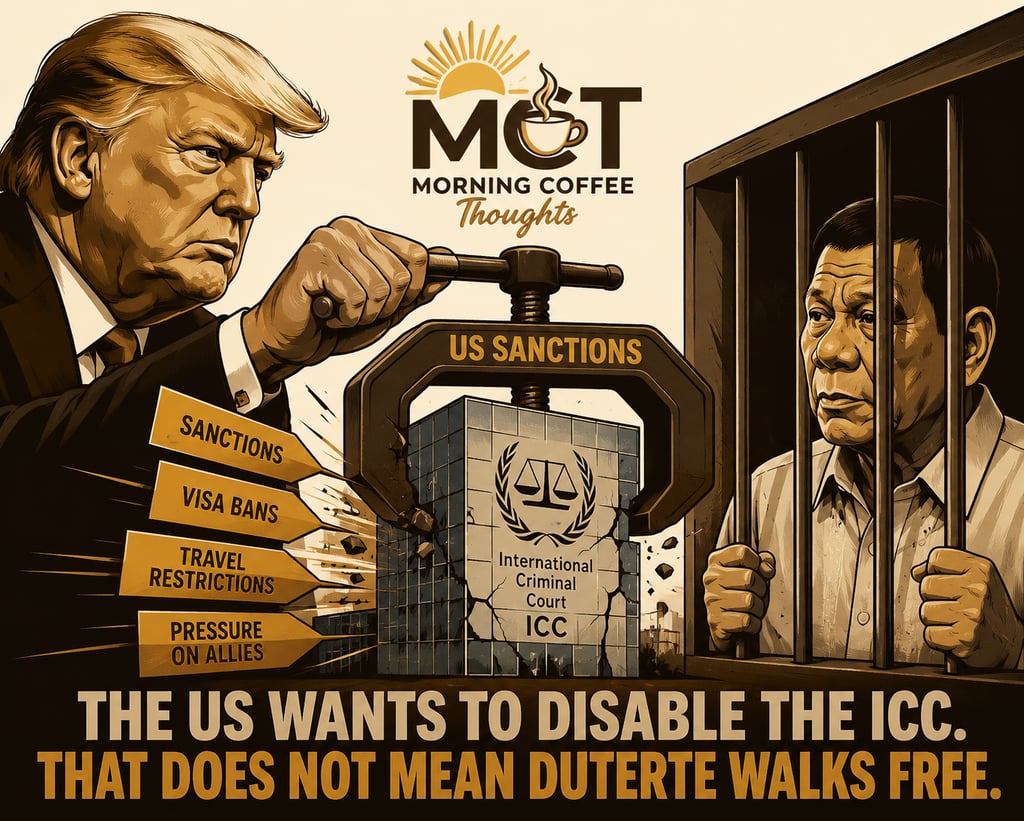
THE US WANTS TO DISABLE THE ICC. THAT DOES NOT MEAN DUTERTE WALKS FREE.
The United States is escalating its campaign against the International Criminal Court. This commentary examines how far Washington can go in weakening the ICC and why that pressure does not automatically mean Rodrigo Duterte walks free.
9 min read
The United States has stopped pretending that its fight with the International Criminal Court is only a disagreement over legal theory.
On July 13, 2026, the US State Department announced a campaign to dismantle what it calls the ICC’s threat to American sovereignty. It said the effort would use the whole US government to restrict the Court’s operations, pressure other countries to leave the Rome Statute, scrutinise states that support the ICC while receiving US assistance, and pursue visa restrictions, travel bans, and further sanctions.
The goal appears much bigger than arguing with the Court over jurisdiction. Washington is trying to make the ICC harder to operate and increasingly costly for governments and institutions that continue working with it.
The United States says the ICC cannot investigate Americans because the US never joined the Rome Statute. Washington makes the same jurisdictional argument in defending Israel, its closest ally in this fight.
Filipinos should recognise part of that argument. We have heard our own version of it for years.
THE QUESTION FOR FILIPINOS
Duterte’s defenders said the ICC had no right to investigate the drug war because the Philippines had withdrawn from the Rome Statute. Washington says the Court has no authority over American citizens because the United States never became a party to the treaty.
The legal circumstances are different.
The Philippines joined the Rome Statute and remained a member during the period covered by the ICC investigation. The Court says its jurisdiction covers alleged crimes committed in the Philippines from November 1, 2011 through March 16, 2019. The Philippine withdrawal took effect after that period.
The United States, meanwhile, has never been an ICC member. In a July 2026 letter, acting Attorney General Todd Blanche argued that a treaty cannot bind a country that did not consent to it. He said the ICC has no authority over Americans anywhere in the world.
Both disputes eventually reach the same argument over jurisdiction. Washington places heavy weight on the nationality of the accused and the consent of that person’s country. The ICC reads the Rome Statute differently.
Under the Court’s position, jurisdiction can also come from the territory where an alleged crime occurred. That distinction is important because the ICC says it can investigate genocide, crimes against humanity, and war crimes committed on the territory of a member state even when the suspect comes from a country that never joined the Rome Statute.
A country’s refusal to join the treaty does not automatically shield all of its citizens from the Court. Withdrawal also does not necessarily erase jurisdiction over alleged crimes committed while a country was still bound by the treaty.
For Filipinos, however, the immediate question is much simpler.
Could the American campaign against the ICC somehow send Rodrigo Duterte home?
Not automatically.
Duterte was arrested by Philippine authorities and surrendered to ICC custody on March 12, 2025. The Court says he is accused of crimes against humanity tied to alleged killings in the Philippines between November 1, 2011 and March 16, 2019.
He challenged the Court’s jurisdiction after the Philippines withdrew from the Rome Statute. The ICC Appeals Chamber rejected that challenge in April 2026.
On April 23, 2026, Pre-Trial Chamber I confirmed the charges brought by the prosecution against Duterte and committed him to trial. The Court describes the confirmed case as involving three counts of crimes against humanity.
The prosecution’s public Document Containing the Charges, dated February 13, 2026, also named Senators Ronald “Bato” dela Rosa and Christopher “Bong” Go among Duterte’s alleged co-perpetrators in the alleged common plan behind the drug war. That remains an allegation by the prosecution, not a conviction.
Their inclusion in that public document should not be erased or softened. The document exists. It is public.
The case against Duterte has therefore moved well beyond the political argument that the ICC should never have been allowed to investigate him in the first place. He is already in ICC custody. His jurisdictional challenge has been rejected.
Charges have been confirmed. His case has been committed to trial.
American pressure on the Court can create serious problems for that process. It does not hand Washington the legal authority to order Duterte released.
WHY THE ICC SAYS TERRITORY COUNTS
The disagreement between Washington and the ICC becomes easier to understand when you look at the Court’s cases involving Israel and Afghanistan. The basic question is whether the nationality of a suspect can place that person beyond ICC jurisdiction when the alleged crime happened somewhere that falls under the Court’s authority.
The ICC says no. Washington strongly disagrees.
WHY THE ICC LOOKED AT ISRAEL
The ICC did not issue arrest warrants against Benjamin Netanyahu and Yoav Gallant simply because the Court wanted a political confrontation with Washington.
Palestine accepted ICC jurisdiction in 2015. The Court later ruled that its territorial jurisdiction in the Palestine situation extends to Gaza, the West Bank, and East Jerusalem. Israel disputes that position.
Israel challenged the Court’s jurisdiction, including its claimed authority over Israeli nationals. In November 2024, the ICC’s Pre-Trial Chamber rejected that challenge. The Chamber concluded that Israel’s consent was unnecessary because the Court could exercise jurisdiction through Palestine’s territorial status.
On November 21, 2024, the Chamber issued arrest warrants for Netanyahu and Gallant.
The judges found reasonable grounds to believe they bore criminal responsibility for the war crime of starvation as a method of warfare and for the crimes against humanity of murder, persecution, and other inhumane acts. The judges also found reasonable grounds relating to the war crime of intentionally directing attacks against civilians.
These were findings made at the warrant stage. They are serious legal findings, but they are not convictions.
The Court said the alleged conduct involved depriving Gaza’s civilian population of objects needed for survival, including food, water, medicine, fuel, electricity, and medical supplies. It found reasonable grounds to believe that restrictions on humanitarian aid, together with electricity and fuel cuts, contributed to that deprivation.
The warrants concern named individuals, particular alleged conduct, and the legal standard of reasonable grounds to believe. They do not assign criminal responsibility for every civilian death in Gaza.
Whether the prosecution can prove the allegations at trial is a separate question. The jurisdictional point, however, is central to the fight now being waged by Washington.
Israel says the ICC has no authority over Israeli nationals without Israel’s consent. The Court’s answer is that territorial jurisdiction can come through Palestine.
That same basic disagreement appears elsewhere.
WHY THE ICC LOOKED AT AMERICANS
The American conflict with the ICC did not begin with Gaza. It goes back to Afghanistan.
In 2020, the ICC Appeals Chamber authorised an investigation into alleged crimes committed in Afghanistan since May 1, 2003. The situation covered alleged crimes by the Taliban, Afghan forces, and US personnel.
The prosecutor’s request included allegations of torture, cruel treatment, outrages upon personal dignity, rape, and other sexual violence involving US armed forces and Central Intelligence Agency personnel. It also covered alleged CIA detention-related conduct in Afghanistan and in ICC member states, including Poland, Romania, and Lithuania.
The investigation did not accuse every American service member of committing a crime. It concerned allegations involving particular personnel and possible responsibility higher in the chain of command.
Washington rejects the Court’s claimed authority. The Justice Department says the United States never consented to ICC jurisdiction and will not cooperate with an ICC investigation, summons, request, extradition, or transfer involving an American.
The Court reaches the issue through territory. Afghanistan was a Rome Statute member when the alleged crimes under investigation occurred. Poland, Romania, and Lithuania are also members.
Under the ICC’s interpretation, alleged crimes committed in those countries can fall under its jurisdiction even when the people suspected of committing them are American.
So the legal dispute is not difficult to identify. Washington argues that the absence of US consent protects Americans from ICC jurisdiction. The Court says the consent given by the country where an alleged crime took place can also provide a legal basis for jurisdiction.
That disagreement is now part of a much larger American effort against the institution itself.
THE US DOES NOT CONTROL THE ICC
The United States can cause serious damage to the Court.
Sanctions can freeze assets under US jurisdiction and restrict access to parts of the global financial system. Visas can be denied. Allies can face political pressure.
Banks, law firms, civil society groups, and other institutions may decide that working with ICC personnel creates too much financial or legal risk.
What Washington cannot do through a presidential order is close the Court.
The ICC exists under the Rome Statute, a treaty with 125 States Parties. Its Assembly of States Parties oversees the Court and makes institutional decisions.
The United States never joined the treaty. It has no vote in that Assembly and no veto over the Court’s continued existence.
Formal changes to the Rome Statute go through the treaty’s amendment process. Any State Party can propose an amendment, while adoption needs approval from two-thirds of States Parties.
There is no switch in the White House that says “close the ICC.”
The more realistic danger is less dramatic but potentially more damaging. The Court could remain open while sanctions disrupt banking, travel, recruitment, witness protection, legal work, and cooperation from governments.
Cases could slow down. Some governments could refuse to arrest suspects. Staff could leave if their families, finances, or ability to travel become exposed to sanctions.
A court has judges and prosecutors. It does not have its own police force.
Arrest warrants depend on governments willing to enforce them. That dependence gives the United States considerable room to weaken the institution even without controlling it.
WHAT HAPPENS TO DUTERTE IF THE ICC IS WEAKENED
The Rome Statute contains rules for countries that withdraw.
Article 127 says withdrawal does not erase obligations that arose while a country was still a member. It also does not halt a case already under consideration.
This is why the Philippine withdrawal did not end the Court’s authority over the period covered by Duterte’s case.
A much harder question appears in an extreme scenario where the ICC itself becomes unable to function, large numbers of member states leave, or the Court is formally dismantled through a future treaty process. The Rome Statute does not provide a clean answer for every possible version of that situation.
Even then, there is no rule saying Duterte would automatically be released and flown back to the Philippines because Washington had crippled the Court. His detention is connected to an executed arrest warrant, a live case, and charges that have already been confirmed.
A paralysed Court could create major legal problems. His trial could be delayed. Questions could arise over detention, funding, staffing, and the responsibilities of the Netherlands as the ICC’s host country.
None of that automatically becomes a legal order releasing Duterte.
A release, transfer, or return would still need some lawful basis through ICC procedures or another agreed process involving the Court, its member states, and the host state. The United States cannot simply order that outcome.
The Philippine government cannot declare Duterte entitled to return merely because American sanctions have damaged the Court.
His status could change through the case itself. Duterte could seek interim release. He could be acquitted after trial.
A future court ruling could alter his legal position. Those are possible legal outcomes arising from judicial proceedings.
American pressure does not automatically produce any of them.
WHAT AN AMERICAN “WIN” COULD ACTUALLY LOOK LIKE
Washington can weaken the ICC without abolishing it.
The effect becomes serious when judges and prosecutors struggle to work, banks refuse transactions, lawyers fear exposure, witnesses lose protection, and governments conclude that cooperation carries too high a political or financial cost.
A court can survive formally while losing much of its practical ability to act. Warrants become harder to enforce when governments refuse arrests.
Investigations suffer when witnesses cannot be protected. Legal proceedings slow when staff, lawyers, institutions, or financial service providers are afraid to work with the Court.
That appears to be where the American campaign poses its greatest danger.
The Duterte case is already moving through that institution. Duterte is in custody. The Court rejected his jurisdictional challenge.
The prosecution’s charges have been confirmed. The case has been committed to trial.
A weakened ICC could make that trial slower and more difficult. Severe institutional paralysis could create legal questions that the Rome Statute was never written to answer cleanly.
What American pressure does not provide is a legal shortcut from an ICC detention facility back to the Philippines.
Washington has considerable power to hurt the Court. Whether it can damage the ICC badly enough to disrupt cases already underway is now a serious question.
But Duterte does not walk free simply because the United States wants the institution holding him weakened.
SOURCES
US Department of State, https://www.state.gov/releases/office-of-the-spokesperson/2026/07/state-department-launches-campaign-to-dismantle-international-criminal-courts-threat-to-american-sovereignty/
US Department of Justice, https://www.justice.gov/opa/pr/justice-department-rejects-international-criminal-court-jurisdiction-over-us-persons
International Criminal Court, Palestine jurisdiction decision and Netanyahu/Gallant warrants, https://www.icc-cpi.int/news/situation-state-palestine-icc-pre-trial-chamber-i-rejects-state-israels-challenges
International Criminal Court, Afghanistan situation, https://www.icc-cpi.int/afghanistan
United Nations News, ICC authorises Afghanistan investigation, https://news.un.org/en/story/2020/03/1058741
Human Rights Watch, ICC Afghanistan inquiry, https://www.hrw.org/news/2022/10/31/icc-afghanistan-inquiry-can-resume
Council on Foreign Relations, ICC Afghanistan inquiry background, https://www.cfr.org/articles/iccs-probe-atrocities-afghanistan-what-know
ICC Assembly of States Parties, https://asp.icc-cpi.int/states-parties
Coalition for the International Criminal Court, https://www.coalitionfortheicc.org/assembly-states-parties
International Criminal Court, Rome Statute, https://www.icc-cpi.int/sites/default/files/2024-05/Rome-Statute-eng.pdf
International Criminal Court, Duterte case, https://www.icc-cpi.int/philippines/duterte
International Criminal Court, Republic of the Philippines, https://www.icc-cpi.int/philippines
International Criminal Court, Duterte case for victims, https://www.icc-cpi.int/victims/duterte-case
International Criminal Court, Document Containing the Charges, https://www.icc-cpi.int/court-record/icc-01/21-01/25-178-red2
International Criminal Court, confirmation decision, https://www.icc-cpi.int/sites/default/files/CourtRecords/0902ebd180e4df59.pdf
International Criminal Court, Appeals Chamber jurisdiction summary, https://www.icc-cpi.int/sites/default/files/2026-04/Duterte-case-appeals-jurisdiction-speaking-notes.pdf
International Criminal Court, statement on Philippine withdrawal, https://www.icc-cpi.int/news/icc-statement-philippines-notice-withdrawal-state-participation-rome-statute-system-essential
University of the Philippines Institute of International Legal Studies, https://law.upd.edu.ph/IILS/pages/draft-on-claims-relating-to-the-investigation-of-the-international-criminal-court-prosecutor-in-the-philippines/
EJIL: Talk!, Amending the Amendment: In Search of an Adequate Procedure
International Criminal Court, Document Containing the Charges, February 13, 2026
Contact us
subscribe to morning coffee thoughts today!
inquiry@morningcoffeethoughts.org
© 2024. All rights reserved.